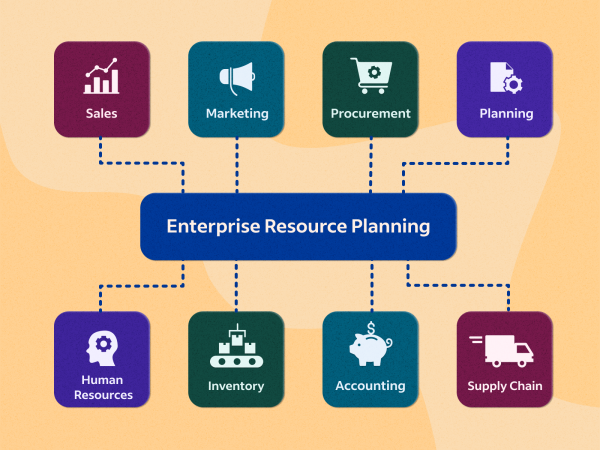

In the modern business world, entrepreneurs' biggest rival is not just market conditions, but also the "information chaos" within the company. Many companies still keep their customer base (CRM) in Excel, manage their projects in Trello or WhatsApp, and conduct accounting in an entirely different program. This dispersion leads to data loss, disconnected communication between departments, and most importantly, a waste of time and money. But is it possible to manage all these processes - from sales to projects, from projects to invoicing - from a single center? Based on official ERP standards and Odoo's fully integrated ecosystem, we will explore ways to transform your business into a unified power in this blog post.
Introduction: How Do "Data Silos" Suffocate Your Business?
The term "Data Silos" describes a situation where different departments of a company use software that is isolated from one another. For example, a sales manager signs a contract with a customer, but the project manager is unaware of the details of this contract. The project is completed, but the accounting department cannot clarify what work was done and how many hours were spent to issue the invoice.
Official reports from international analytical firms like Gartner and Deloitte show that unintegrated systems reduce employee productivity by 20-30%. The solution is simple: A unified ERP system that connects all business processes on the same database. Odoo is built precisely on this philosophy.
1. CRM: The Starting Point of Sales and Customer Information
Every successful business starts with the first contact with the customer. The Odoo CRM module is not just a contact list; it is the visual management center of the sales pipeline. According to official Odoo documentation, the CRM module offers a wide range of features, from the automatic registration of potential customers (Leads) to sales forecasting.
The advantage of a unified system lies here: Customer information is entered into the CRM once, and this information is used over and over again throughout the entire chain - in project management, timesheets, and invoicing. While negotiating with a customer, the sales manager can see their past projects, payment history, and current tasks on the same screen. This ensures a more personalized and professional approach to the customer.
2. Automatic Transition from Sales to Project: Error-Free Transformation
In many companies, the biggest delay occurs in the period between the confirmation of the sale and the start of the project. When data is manually transferred from one system to another, details are forgotten or misunderstood.
In Odoo, this process is fully automated. The moment a sales offer (Quotation) is signed online by the customer or confirmed by the manager, the system can automatically take the following steps:
-
Creates the corresponding project.
-
Forms tasks based on the lines in the sales offer.
-
Sends notifications to the project manager and executors.
Thanks to this integration, the question of "what did sales promise, what is the project executing" disappears. Everything is automatically linked according to the technical terms in the sales contract.
3. Project Management and Timesheets: Transparency and Discipline
Project management is not just keeping a list of tasks, but also the efficient management of resources and time. The Odoo Project module simplifies task execution with Kanban, Gantt, and Calendar views.
However, the true power of the system lies in its integration with the Timesheets module. Employees record the time spent on each task they execute via the mobile app or web browser. According to official Odoo statistics, filling out timesheets directly from tasks increases time tracking accuracy by 40%.
| Process | In Scattered Systems | In Odoo's Unified System |
|---|---|---|
| Time Tracking | On Excel or paper | Instant from the task (with Timer) |
| Status Tracking | Via meetings or calls | Real-time on a visual Kanban board |
| Resource Planning | Estimated and inaccurate | With Workload analytics |
4. Accounting and Invoicing: Turning Time into Money
For businesses operating in the service sector, one of the biggest challenges is invoicing the completed work to the customer accurately and on time. In scattered systems, after a project ends, the accounting department spends days collecting timesheets, checking prices, and preparing an invoice.
Odoo's Accounting and Invoicing modules handle this process within seconds. Based on the "Time & Materials" model, timesheets recorded in the project are automatically converted into an invoice.
-
The system selects approved hours.
-
Applies the hourly rate from the sales contract.
-
Creates the invoice and sends it to the customer via email.
This accelerates Cash Flow and ensures that no work hour is "forgotten." For the entrepreneur, this means full transparency of the financial side of the work.
Odoo's Specific Integration Capabilities in the Azerbaijan Market
For Azerbaijani entrepreneurs, managing CRM, projects, and accounting from a single center also means compliance with local legislation and market demands. Odoo's open architecture allows local partners to create specific integrations for Azerbaijan.
Today, local companies utilize the following features through Odoo:
-
E-invoice and Tax Integration: Direct transmission of invoices generated when a project is completed or a sale is confirmed to the state tax service system.
-
API Connection with Local Banks: Automatic reconciliation of payments made by customers via bank statements with the corresponding project or sales order in Odoo.
-
National Currency and Exchange Rate Updates: Daily automatic loading of official exchange rates from the Central Bank of Azerbaijan (CBAR) into the system, simplifying the accounting of projects in foreign currency.
Such localization capabilities take Odoo beyond just being a global program and turn it into a full-fledged business management system that meets all the requirements of the Azerbaijani market.
Mobile Management: Your Business Always in Your Pocket
For the modern entrepreneur and manager, being tied to the office is a thing of the past. Odoo's official mobile app (iOS and Android) allows you to manage all these integrated processes on the go.
-
Sales: Create new opportunities in CRM and send quotes to customers while on the road.
-
Projects: Check task statuses, approve employee timesheets, and track project progress.
-
Accounting: View incoming payments, and upload expenses (travel, fuel, etc.) to the system by taking photos of receipts.
This mobile accessibility dramatically increases decision-making speed and minimizes "human factor" delays in business management.
5. ROI of Unified Management: Analytics and Decision Making
The biggest reward of managing business processes from a single center is Data Analytics. In Odoo, the profitability of each project (Project Profitability) is calculated automatically.
-
Revenue: Invoices issued to the customer via the CRM and Sales module.
-
Expense: Payroll costs calculated based on employee timesheets and materials purchased for the project.
With the push of a button, an entrepreneur can see which customer is more profitable, which project exceeds the budget, and which employee is more productive. Managing a business without this data is like driving in the dark. A unified system provides you with a powerful "headlight" that illuminates every detail.
Transitioning to Unified Management with Odoo: How to Start?
This transition may seem complicated, but thanks to Odoo's modular structure, you can start with "small steps":
-
Analysis: Identify which programs you currently use and where data "disconnects."
-
Pilot Modules: Launch the CRM and Sales modules first.
-
Phased Integration: Then add Project Management and Timesheets.
-
Financial Chain: Activate Accounting and automatic invoicing in the final stage.
-
Training: Take advantage of official Odoo training or support from local partners to ensure your team understands the benefits of a unified system.
Conclusion: The Business Model of the Future - Integration
Companies wanting to gain a competitive edge in the business world of 2026 can no longer waste time with scattered programs. Unifying accounting, project management, and CRM processes on a single platform is not just a "convenience"; it is a strategic necessity for business survival and growth. Odoo, with its official and fully integrated applications, is the most powerful tool to realize this transformation. Take the step today to move from chaos to order and manage your business from a single center. Remember, technology should work for you, not you for technology.